
Morris Township Previous Residents by Era
Previous residents of a Morris Township address leave a trail in more than one custodian's files. Start with the present parcel record to capture the block, lot, qualifier, legal municipality, and name shown for assessment purposes. Then match that information to the Morris County Clerk's recorded-document index. The clerk records deeds, mortgages, liens, maps, and related instruments countywide. For household history, the Morristown & Morris Township Library adds address directories, microfilm census material, maps, and newspapers. None of those sources alone proves a continuous list of occupants, so label each result as an assessed owner, recorded party, directory occupant, or historical clue.
| Source | Time span | Where held | Address evidence |
|---|---|---|---|
| County Clerk recorded index | Online from 1960 | Morris County Clerk | Recorded parties, document dates, book/page, and legal-description leads |
| Tax Board and assessor records | Current and tax-year specific | Morris County Tax Board and Morris Township assessor | Assessed owner, situs or mailing details, block, lot, and assessment context |
| Library directory holdings | 1873-74 and selected later runs | Morristown & Morris Township Library | Historical address, household, business, or locality clues in a specific volume |
| Federal census schedules | Released on the federal schedule | Library databases and archival sources | A dated household snapshot that must be compared with the address evidence |
| Maps and newspapers | Collection-specific | Library, State Archives, and historical partners | Map labels, notices, obituaries, and date or page leads |
Use the era to choose the first record. A recent transfer usually starts with the Tax Board and Clerk. An older Morris Township house may require a directory volume, a map sheet, and a newspaper index before a former name can be tested in deed or probate material. The library's collections are useful for that historical layer, while a current parcel search is the better starting point for a modern address.
Morris Township Previous Residents Deed Index
The Morris County Clerk recorded-document search is free and its online property index reaches back to 1960. Its search tabs include Party, Document Type, Instrument Number, Book/Page, Town, and Lot/Block. When a Morris Township owner is already known, begin with Party Name, enter the last name first, and do not use commas in a company name. Narrow a broad name result by town, date, document type, lot/block, or legal-description text. The index can return unrelated county records for a common name, so compare every candidate with the parcel facts before treating it as part of an address history.
The Clerk's index is one access channel, not the entire archive. Older records, certified copies, and non-watermarked copies go through the Records Vault at 10 Court Street, first floor, Morristown. The Vault lists 973-285-6747 and weekday hours of 8:00 to 4:30. The general Clerk office is separate from the Morris Township municipal office. A document image, status flag, recording date, and book/page should be kept with the search notes. The portal help says R identifies a replaced record and C a correction, so the controlling image deserves a close read.
The official Clerk search screen shows the Party, document, book/page, town, and lot/block routes used for a Morris Township previous-residents trace.
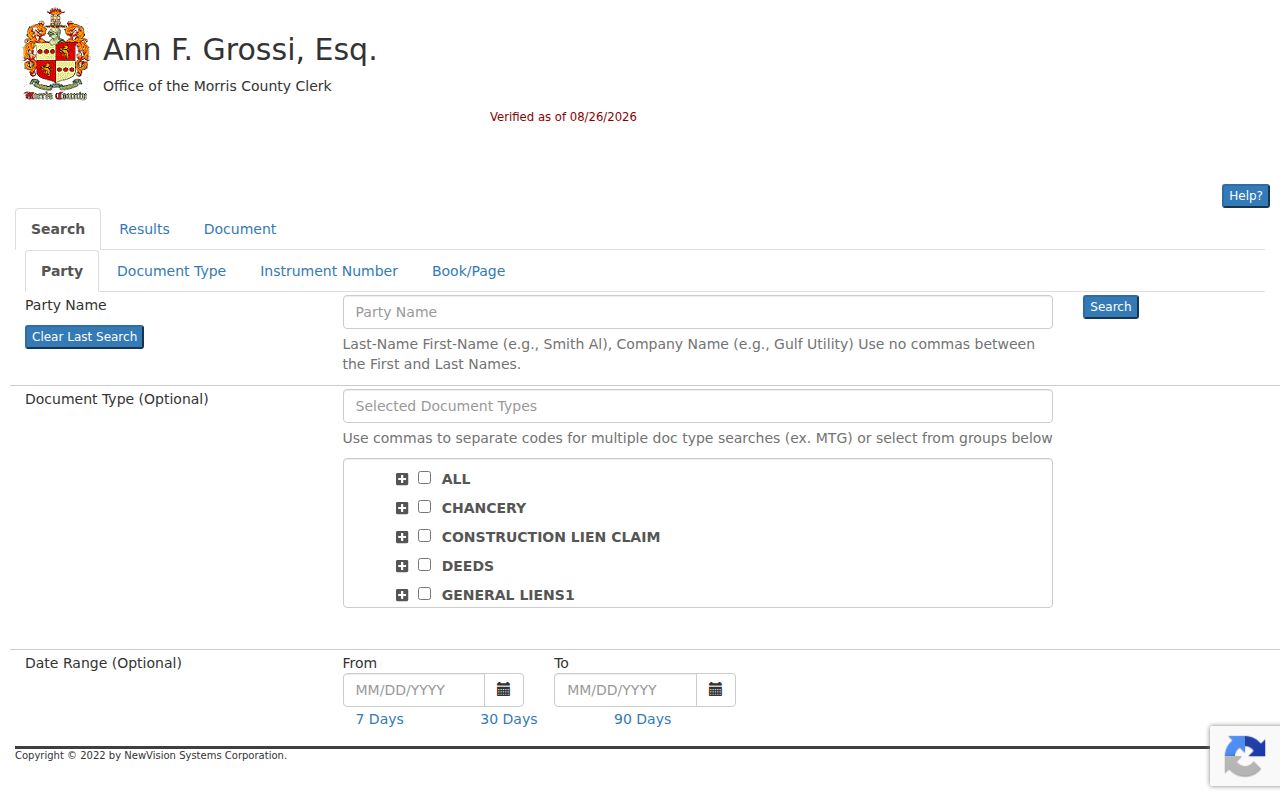
Those controls make it possible to move from a parcel key to the recorded instruments that explain a Morris Township transfer.
Trace Morris Township Previous Residents Deed Chain
A Morris Township deed chain starts with a current parcel record, not with a surname guess. The County Tax Board can search by location, owner, block/lot, and prior block/lot. Its owner is an assessment entry, not automatic proof of current title or occupancy. Use the Tax Board, the Morris Township assessor, and GIS to establish the parcel key, then use the Clerk index to find the recorded transfer. A recent deed can reach the assessor after a lag, so compare the recording date with the tax record rather than assuming either source has already replaced the other.
- Search the Morris Township address in the Tax Board and save the tax year, district, block, lot, qualifier, and owner name shown.
- Open the parcel in GIS and compare the map context with the Tax Board result. Treat the polygon as a reference tool, not a survey.
- Search the recorded index for the current owner's acquisition. Test Party, Town, Lot/Block, date, and document type where needed.
- Read the purchase deed and identify the seller. Search that seller as a grantee to locate the earlier acquisition, then repeat backward.
- When the online chain reaches its 1960 boundary, ask the Records Vault about the older book, image, or copy route. Preserve each instrument number and page reference.
- Grantor
- The party conveying an interest in a recorded instrument, commonly the seller in a deed.
- Grantee
- The party receiving that interest, commonly the buyer named on the deed.
- Chain of title
- The sequence of recorded transfers used to follow a parcel backward. It is a research trail, not a legal title opinion.
- Legal description
- The parcel description carried in a record. It can connect older documents when a street address or postal label changed.
Note: A mortgage, lien, release, or map can be important parcel context, but it does not by itself establish present ownership.
Morris Township Previous Residents in Directories
Deeds trace recorded parties. They do not reliably identify everyone who lived at a Morris Township address. For the household layer, the North Jersey History & Genealogy Center at the Morristown & Morris Township Library holds city directories, street-address runs, telephone directories, census microform, newspapers, maps, and vertical files. Morris County directories begin in the holdings with 1873-74, while Morristown and Morris Township runs appear unevenly across later decades. Read the exact volume and page because a directory can include nearby towns and may list an occupant, a business, or an organization rather than a resident.
Pair a directory entry with the closest released census schedule only after checking the street and date. The census is a time slice, not a live roster. The library's newspaper holdings can then provide a notice date, obituary lead, or locality spelling to test against probate and the deed chain. The historical shelf itself is described in the Morris Township city directories collection, while this address trail stays focused on who lived here before.
- Write down the exact address, printed locality, volume year, and page from the directory.
- Use the map or parcel description to decide whether the historic address plausibly matches the current Morris Township parcel.
- Check the nearest released census schedule for a dated household comparison, preserving the jurisdiction printed in that record.
- Use a newspaper notice or probate index as a lead, then test the name and date against the Clerk's recorded documents.
Morris Township Maps Bridge Address Gaps
Old map layers can make a Morris Township address trail more precise. The library's house and property research material identifies more than 10,000 maps, including the 1868 Beers, 1887 Robinson, and 1910 Mueller atlases or maps, plus historical photographs and municipal surveys. The Morris County Historical Society also points researchers to the 1853 county map, the 1868 Beers atlas, the 1887 Robinson atlas, and the 1910 Mueller atlas. These sources can connect a road, estate name, rural building, or historic locality to a later parcel, but they do not replace a deed, survey, or current parcel report.
The 1909 Library of Congress Sanborn resource is specifically for Morristown. It is not a complete Morris Township map set. For a Morris Township house, use the library's broader map holdings and compare an historical sheet with the current GIS parcel, block/lot, and legal description. Appointments are encouraged for non-circulating material, and the library asks researchers to provide a topic, call number, or date when possible.
Note: Preserve a map sheet number, publication date, and printed locality with every historical land or address clue.
Morris Township Postal Labels
A Morristown postal label does not establish that an old or current parcel lies in the separate Town of Morristown. Morris Township and Morristown separated in stages associated with 1865 and 1895, and Morris Township records can also carry the Convent Station postal label. The township's own physical municipal address uses Morristown, while its mailing address uses Convent Station. Those labels are useful search terms, not legal-municipality proof.
For earlier Morris Township previous residents, test the locality printed in the source rather than silently changing it. Washington Valley, Pruddentown, Normandy Park, Convent Station, and Morristown can all be useful historic search terms. Search both Morris Township and Morristown around the separation dates, then compare the result with the current parcel's legal municipality. No official township-wide street-renumbering or address-alias table was located, so a supposed renumbering must not be invented. The map series, directory address, and deed legal description are the documented crosswalk.
Note: Keep the source's postal city and locality in the notes, then add the normalized municipality as a separate field.
Morris Township Owner and Occupant Checks
Use precise labels throughout a Morris Township house history. The Tax Board may show an assessed owner or taxpayer. GIS supplies parcel geometry and map context. The Clerk identifies recorded parties and instruments. A directory or census can supply an occupant clue for a defined year. A mailing address that differs from the situs address may be useful for correspondence, but it does not show who lived at the property. A parcel owned by an estate, trust, company, or absentee owner needs the same care.
The Tax Board's data are provided as-is, and the county GIS states that its data are not a survey or legal description. Verify any important ownership conclusion with the recorded instrument and the relevant custodian. The Morris Township assessor can provide property-card context and has a separate request route for 200-foot owner lists, but that service remains an assessment record route rather than a historical household register.
Note: A different mailing address can be a useful record detail, but it should never be converted into an occupancy claim.
Morris Township House History Boundaries
House-history research is strongest when it stays focused on the property, the source date, and a defined historical question. Recorded documents can contain names and addresses, but public access does not turn a past address into permission to follow or contact a living person. New Jersey's Address Confidentiality Program uses substitute addresses for eligible participants, and voter, court, motor-vehicle, and other records have separate restrictions. Records can also be delayed, incomplete, or wrong.
Lawful personal use. Use Morris Township previous-residents research for family history, a house history, estate questions, or personal curiosity. Do not use records to track, intimidate, repeatedly contact, or harass anyone. New Jersey stalking and harassment laws, including N.J.S.A. 2C:12-10 and 2C:33-4, remain in force.
Morris Township Previous Residents Research Log
A careful log helps separate a real Morris Township connection from a same-name result. Previous residents research needs the source, access date, query, record date, parcel identifiers, printed locality, and limitation for every hit. For a Clerk result, retain the party role, instrument number, book/page, recording date, town, lot/block, and image or status notation. For a library item, keep the directory volume, page, map sheet, call number, or newspaper date. That recordkeeping also makes it easier to return to the right office when an early result is corrected or a source uses an older locality name.
When the evidence conflicts, do not force a match. The best next step may be the Records Vault, a library appointment, the Tax Board, the Morris Township assessor, the Surrogate for an estate lead, or the State Archives for a qualifying historical record. Each office keeps a different part of the Morris Township trail.